Project Management for Startups: Your 30/90-Day Plan

Start today: the founder (or whoever owns the product) runs project management, uses a Kanban board, and holds a 15-minute weekly sync. That setup works until you hit three concurrent product streams or start missing milestones repeatedly.
Three things to do right now:
- Centralize your workspace. Pick one tool and move every task, decision, and file there. Scattered Slack threads and shared Google Docs are where context goes to die.
- Set one north-star metric. Decide what “done well” looks like this sprint: shipped features, validated signups, or reduced churn. One number, visible to everyone.
- Run a 15-minute kickoff. Today. Who owns what, what’s blocked, what ships this week. That’s the whole agenda.
When should this change? When you’re managing more than three product streams simultaneously, when milestones slip two sprints in a row, or when investor updates start eating your engineering time, it’s time to bring in dedicated PM capacity.
Key Takeaways
The single most important move in startup project management is centralizing decisions and tasks in one shared workspace before your team grows past five people.
| Point | Details |
|---|---|
| Start with Kanban + weekly sync | The founder runs PM early; add a dedicated PM only when three or more concurrent streams cause repeated missed milestones. |
| Use the 5 Cs to diagnose gaps | Score Coordination, Communication, Control, Clarity, and Consistency at day 30 and day 90 to find your weakest link. |
| 30-day foundation first | Centralize work, set one north-star metric, create a backlog, and run your first retro before adding any new process. |
| Adapt, don’t adopt, a methodology | Kanban suits continuous work; Scrum suits defined releases; Lean/PDCA suits pre-PMF experimentation. Mix as needed. |
| Seven for privacy and portability | At $9/user/month with open data export and no data mining, Seven fits the 30/90-day plan without vendor lock-in. |
Table of Contents
- Why project management for startups actually protects your runway
- Who should run projects early, and when do you hire a PM?
- Which methodology fits your startup right now?
- Your concrete 30- and 90-day setup plan
- The artifacts and rituals your team actually needs
- How to choose a project tool, and why Seven fits early-stage teams
- Common mistakes startups make in project management
- The 5 Cs diagnostic: a quick health check for your PM setup
- What founders actually get wrong about project management
- Seven gives you a clean start without the overhead
- Sources
Why project management for startups actually protects your runway
Most founders treat project management as corporate overhead. That’s the wrong frame. At a four-person startup, a missed handoff doesn’t just delay a feature — it burns cash, erodes trust, and compounds into the next sprint.
The PMI’s toolkit for startups identifies four core failure modes that structured practices directly address: poor risk management, unclear task priorities, cost estimation drift, and communication breakdown.
The concrete benefits for a small team:
- Faster decisions. A shared backlog means you stop relitigating priorities in every meeting.
- Clearer handoffs. New hires ramp faster when decisions live in a documented workspace, not in someone’s head.
- Protected runway. Scope creep is a cash problem. A visible backlog with explicit acceptance criteria makes scope creep harder to ignore.
- Better investor communication. A living roadmap cuts the time you spend assembling status updates from scratch.
The trade-off is real: any ceremony costs time. A daily standup that runs 45 minutes is worse than no standup. The goal is the lightest process that keeps the team aligned, not the most thorough one.
Consider a founder with three developers. Without a central hub, each developer is working from a slightly different mental model of the sprint. One builds a feature the founder already deprioritized in a Slack DM two days ago. That’s a week of engineering time gone. A single shared board with one prioritized column prevents it.
Who should run projects early, and when do you hire a PM?
In the first six to twelve months, the founder runs project management. Not because it’s glamorous, but because no one else has the context to make the right trade-offs fast. The engineering/product/design trio can share ownership of rituals (standups, retros), but someone needs to own the backlog and the roadmap.
HBR makes the case that project managers who think like founders — tying every task to a business outcome, making trade-offs quickly, and staying close to execution — produce better results in startup contexts. That’s exactly why a founder doing PM is often more effective than a hired PM who doesn’t yet understand the business.
Signals that it’s time to add dedicated PM capacity:
- You’re running more than three concurrent product streams and context-switching is costing you two or more hours a day.
- You’ve missed the same type of milestone two sprints in a row.
- Stakeholder communication (investors, enterprise customers, partners) is consuming more than 20% of your week.
- New hires are taking several weeks to understand what’s being built and why.
When those signals appear, you have three options, roughly in order of preference for an early-stage startup:
- Fractional PM. A senior PM working 10–20 hours a week. You get experience without a full-time salary. Best for teams of 5–15 people managing one or two product lines.
- PM contractor. Project-scoped, fixed term. Good for a specific launch or a complex integration sprint.
- Full-time PM hire. Justified when you have consistent multi-stream complexity and the revenue to support it. Premature hiring here is expensive.
PMTraining’s guidance reinforces this: the earliest stage rarely needs a dedicated PM, but the practices matter from day one.
Which methodology fits your startup right now?
The honest answer: most startups don’t need to pick a methodology. They need to pick one and adapt it. Forbes warns explicitly against dogmatic application of any single framework — the startup that runs textbook Scrum with two-week sprints, full ceremonies, and a dedicated Scrum Master at ten people is wasting time it doesn’t have.
Here’s a quick decision guide:
Use Kanban if:
- Your work is continuous and unpredictable (support, ops, content, bug fixes).
- You have no fixed release cadence.
- You want the lowest possible setup cost.
Use Scrum if:
- You ship in defined increments (features, product releases).
- You have at least three people who can commit to a sprint.
- You want structured retrospectives to improve velocity over time.
Use Lean/Build-Measure-Learn if:
- You’re still validating the product idea.
- You need to run experiments faster than you ship features.
- Your biggest risk is building the wrong thing, not building slowly.
Use Scrumban if:
- You started with Scrum but your work keeps spilling out of sprint boundaries.
- You want sprint planning discipline with Kanban’s flow flexibility.
The PDCA cycle from Lean.org (Plan-Do-Check-Act) pairs naturally with MVP-driven roadmaps: short cycles let you validate assumptions fast and update the backlog before you’ve over-invested in the wrong direction. For pre-product-market-fit teams, this is often more valuable than sprint velocity.
Coursera’s overview of project management types is a solid primer if you want a neutral comparison of Agile, Waterfall, and hybrid approaches before committing.
One practical adaptation worth noting: instead of fixed sprint delivery, run timeboxed experiments. Set a two-week window, define the hypothesis, ship the minimum version, measure. That reframe turns a sprint from a delivery commitment into a learning commitment, which is more honest about what early-stage work actually is.
Your concrete 30- and 90-day setup plan
The first 30 days: build the foundation
Week 1
- Choose one tool and migrate everything into it. No parallel systems.
- Create a backlog with at least 20 items. Don’t worry about estimates yet.
- Define your north-star metric for the next 30 days.
- Run your first weekly planning meeting (30 minutes max). Agenda: what shipped last week, what’s the top priority this week, what’s blocked.
Week 2
- Add owners and due dates to every backlog item in the current sprint.
- Start a 15-minute daily sync. Three questions: what did you do yesterday, what are you doing today, what’s blocked.
- Create a simple Now/Next/Later roadmap. Three columns, five items max per column.
Week 3
- Run your first retrospective. Keep it to 20 minutes: what worked, what didn’t, one thing to change.
- Review the backlog and cut anything that hasn’t moved in two weeks.
- Write a Definition of Done for your most common task type (e.g., “feature shipped = code reviewed, tested on staging, and release note written”).
Week 4
- Review the north-star metric. Did you move it? Why or why not?
- Refine the roadmap based on what you learned.
- Assess: is the current cadence working, or does something need to change?
30-day success indicators: Every team member can answer “what are we building this week and why” without asking the founder. The backlog is visible and prioritized. At least one retrospective has happened.
Days 31–90: build repeatability
- Introduce sprint planning (if using Scrum) or a weekly backlog review (if using Kanban).
- Add a monthly stakeholder update using the roadmap as the source of truth.
- Start tracking velocity or throughput, whichever fits your method.
- At day 60, run a process audit: which rituals are adding value, which are theater?
- At day 90, decide whether the current methodology still fits or needs adjustment.
New team members onboard using the documented workspace. The founder spends less than two hours a week on coordination overhead.
The artifacts and rituals your team actually needs
Notion’s startup playbook makes a strong case for lightweight, living documents over polished, static ones. A roadmap that gets updated weekly is worth ten times a beautifully formatted one that’s three months stale.
Backlog card fields
Every task card should have: title (one clear action), outcome metric (how you’ll know it’s done well), owner (one person, not “the team”), estimate (rough: small/medium/large), and dependencies (what must be true before this starts).
Roadmap format
Use Now/Next/Later. “Now” is the current sprint or two-week window. “Next” is the following sprint. “Later” is everything else. Resist the urge to date “Later” items — you don’t know enough yet.
Rituals that earn their time
- Daily standup (15 minutes). Three questions, standing up, no laptops. If it runs long, something is wrong with the backlog, not the standup.
- Weekly planning (30 minutes). Review what shipped, pull the next priority items, confirm owners.
- Monthly retro (45 minutes). Start/Stop/Continue format. Write the outcomes down and act on at least one item before the next retro.
Definition of Done checklist
A task is done when: code is reviewed (if applicable), tested in a staging environment, documented in one sentence, and the relevant stakeholder has been notified. Adjust for your context, but write it down and use it consistently.
How to choose a project tool, and why Seven fits early-stage teams
The wrong tool is worse than no tool. A platform with a steep learning curve kills adoption before the first sprint ends. Here’s what to evaluate:
- Adoption cost. Can a new hire be productive in under an hour?
- Flexibility. Does it support boards, lists, and a roadmap view without requiring a premium tier?
- Data portability. Can you export everything if you need to switch? Vendor lock-in is a real cost.
- Privacy policy. Does the platform mine your project data for analytics or AI training? For startups with sensitive roadmaps, this matters.
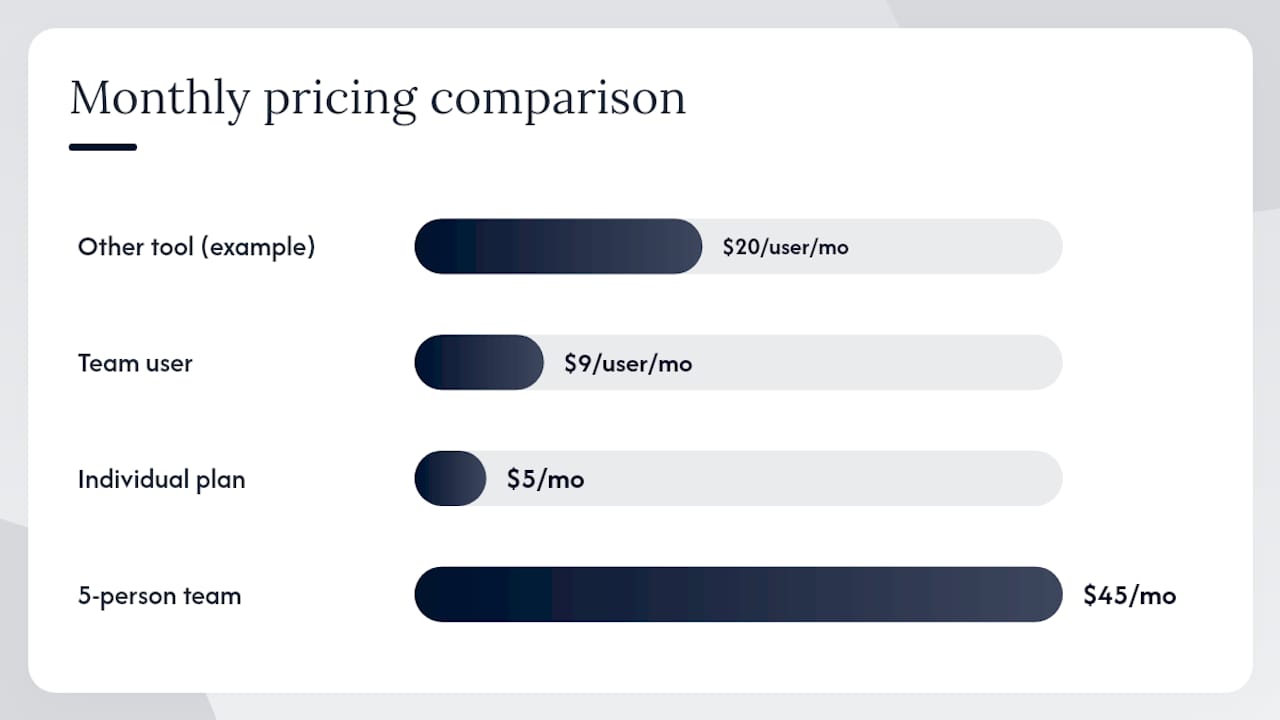
- Pricing. Per-user costs compound fast. A $20/user/month tool at 15 people is $3,600 a year before you’ve shipped anything.
Seven checks each of these boxes in a way most startup tools don’t. Flexible workspaces, built-in messaging, file attachments, due date tracking, and overdue alerts cover the daily workflow. The Excel import means you can migrate from a spreadsheet in minutes, not days. Critically, Seven doesn’t mine your data or sell analytics — your roadmap stays yours. Open data export means you’re never locked in.
Pricing is transparent: $5/month for individuals, $9/user/month for teams, with a 7-day free trial. At a five-person team, that’s $45/month, which is hard to argue with.
Pro Tip: Start with one board per product stream. Don’t build out the full workspace on day one — let the structure emerge from how your team actually works over the first two weeks.
Common mistakes startups make in project management
Most startup PM failures aren’t about methodology. They’re about discipline.
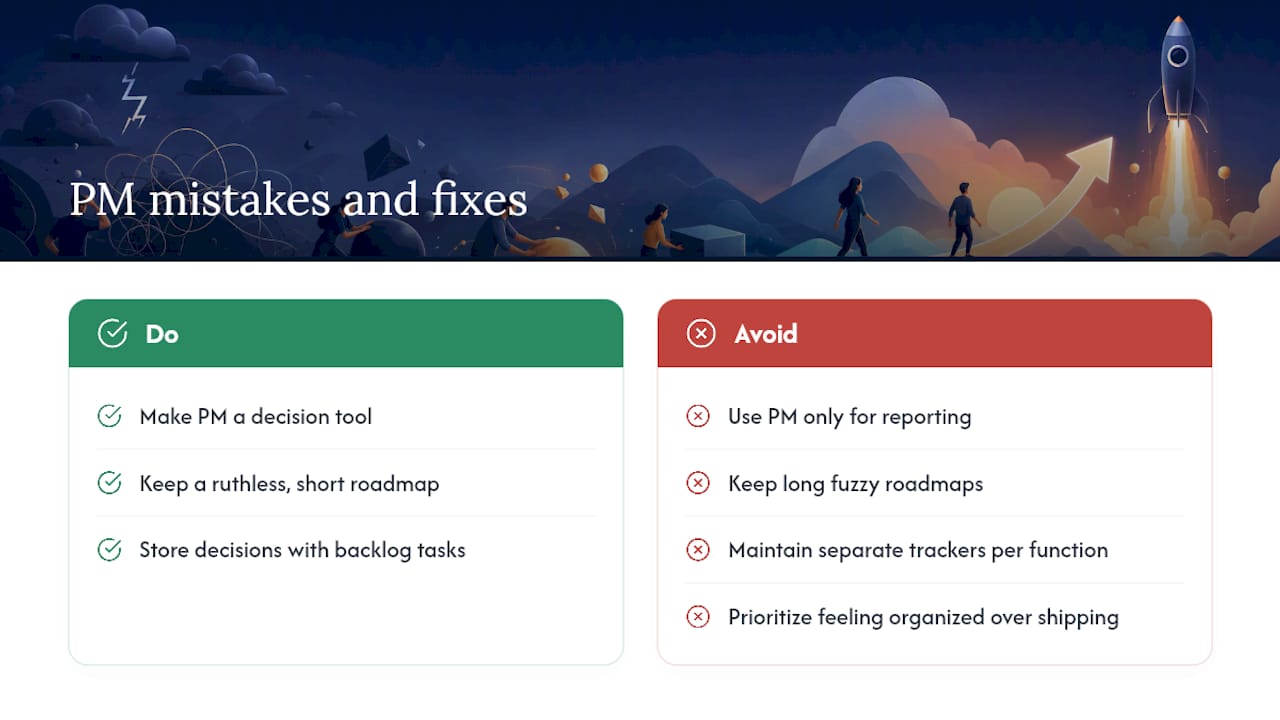
- Scope creep. Fix: timebox every sprint and require a written change request to add scope mid-sprint. If it’s urgent, something else comes out.
- Overplanning. A 40-item sprint backlog with detailed estimates for items you won’t touch for six weeks is wasted effort. Plan two weeks out in detail, sketch the rest.
- Outcome ambiguity. “Improve onboarding” is not a task. “Reduce time-to-first-value from 14 minutes to 8 minutes by Friday” is. Every backlog item needs a measurable outcome.
- Tool sprawl. If your team is using Slack for decisions, email for approvals, a spreadsheet for the roadmap, and a separate tool for tasks, you have four sources of truth and zero. Pick one hub.
- Siloed communication. Decisions made in a DM that never make it to the shared workspace create invisible dependencies. Default to writing decisions in the project tool, not in private messages.
Pro Tip: Run a “communication audit” in week two. Ask each team member where they went to find information in the last 48 hours. If the answers vary, you have a tool sprawl problem, not a people problem.
The 5 Cs diagnostic: a quick health check for your PM setup
The PMI’s startup toolkit organizes execution health around five dimensions. Score each one from 1 (broken) to 5 (working well) and act on your lowest score first.
- Coordination. Does everyone know what everyone else is working on? Action: add a shared board with owner columns visible to the whole team.
- Communication. Are decisions documented where the team can find them? Action: move all project decisions out of DMs and into the project workspace.
- Control. Do you have visibility into what’s on track and what’s at risk before it’s too late? Action: add a “blocked” status to your board and review it at every standup.
- Clarity. Does every task have a clear owner and a measurable outcome? Action: reject any backlog item that doesn’t have both before it enters a sprint.
- Consistency. Are rituals happening on schedule and producing usable outputs? Action: put every recurring meeting in the calendar with a fixed agenda template.
Fold this diagnostic into your 30-day review. Score the 5 Cs at day 30 and again at day 90. If any score hasn’t moved, the ritual or artifact tied to it isn’t working.
What founders actually get wrong about project management
The most common mistake isn’t skipping standups or ignoring the backlog. It’s treating project management as a reporting tool rather than a decision-making tool.
A roadmap that exists to satisfy investors is a different artifact from a roadmap that helps your team make trade-offs on a Tuesday afternoon. Build the second one. The first one will follow.
Three things worth being direct about:
Be ruthless about the roadmap. Every item you add to “Next” is a commitment you’re making to your team. If you’re not willing to defend it in a retro, cut it now. A short roadmap with clear priorities beats a long one with fuzzy ones every time.
Centralize decisions, not just tasks. The backlog is where work lives. Decisions about why that work matters need to live there too. A task without context is just a to-do list. A task with a linked decision record is a shared mental model.
Integrate PM with product, marketing, and sales from the start. A product sprint that ships a feature marketing doesn’t know about is a missed launch. A sales promise that engineering doesn’t know about is a scope crisis. The fix is simple: one shared roadmap, visible to all three functions, updated weekly. Not three separate trackers that get reconciled in a quarterly meeting.
The HBR framing holds here: the best PM mindset for a startup is a founder mindset. Every process decision should be evaluated against one question: does this help us ship the right thing faster, or does it just make us feel organized?
Seven gives you a clean start without the overhead
Most project tools were built for enterprise teams and then scaled down. Seven was built for exactly the kind of team this guide describes: small, fast-moving, and unwilling to pay for features they’ll never use.
You get flexible workspaces, built-in messaging, file attachments, due date tracking, and overdue alerts — everything the 30/90-day plan above requires. The Excel import means your existing spreadsheet backlog is live in minutes. Open data export means you own your project data, always. And because Seven doesn’t mine your data or train AI models on your roadmap, your competitive plans stay private.
Pricing is straightforward: $5/month for solo founders, $9/user/month for teams, with a 7-day free trial to test the full feature set before committing. No hidden tiers, no per-feature paywalls. For a five-person team, that’s less than most founders spend on coffee in a week.
Start the trial, create one board for your current sprint, and run your first standup with it tomorrow. That’s the whole implementation plan.
Sources
These are the sources that shaped this guide, worth bookmarking if you want to go deeper on any section.
- PMI Guide for Startups
- Project Managers Should Think Like Startup Founders
- The Best Project Management Framework For Startups - Forbes
- Types of project management - Coursera