Data residency in SaaS: where compliance meets architecture

Data residency in SaaS means controlling the specific geographic location where a customer’s data is stored, processed, and backed up, including disaster recovery copies. For multi-tenant platforms, this is an architectural constraint, not a legal afterthought. It shapes how you route requests, where you replicate data, and which regions you can sell into.
Three things to do this week, before your next enterprise deal stalls in procurement:
- Classify in-scope data — separate what actually needs regional control from what doesn’t.
- Map every data flow — including logs, backups, and analytics pipelines, not just primary storage.
- Add residency clauses to your DPAs — before a customer’s legal team asks why they’re missing.
Key Takeaways
Data residency in SaaS succeeds when regional pinning is designed into the request lifecycle from the start, not retrofitted after a customer asks where their data lives.
| Point | Details |
|---|---|
| Residency, sovereignty, localisation differ | Residency is location, sovereignty is governing law, localisation forbids transfer entirely. |
| 62 jurisdictions now regulate this | 18 run strict localisation regimes with no transfer safeguard available. |
| Adjacent paths cause most failures | Shared logging, backup replication, and support access leak data across regions most often. |
| Classify before you duplicate | Not all data needs regional isolation, so classify first to avoid unnecessary infrastructure cost. |
| Seven avoids the analytics leak entirely | No data mining or AI training on customer data, with full export and no vendor lock-in. |
Table of Contents
- What is data residency in SaaS, and how does it differ from sovereignty and localisation?
- Which countries have the strictest data residency requirements?
- Why does ignoring data residency get expensive fast?
- How do you design SaaS architecture to prevent residency failures?
- What should you demand from vendors and subprocessors?
- How do you monitor data residency once it’s implemented?
- How does Seven approach data residency and privacy by design?
- What conventional data residency advice gets wrong
- Where Seven fits if privacy and control are non-negotiable
- Sources
What is data residency in SaaS, and how does it differ from sovereignty and localisation?
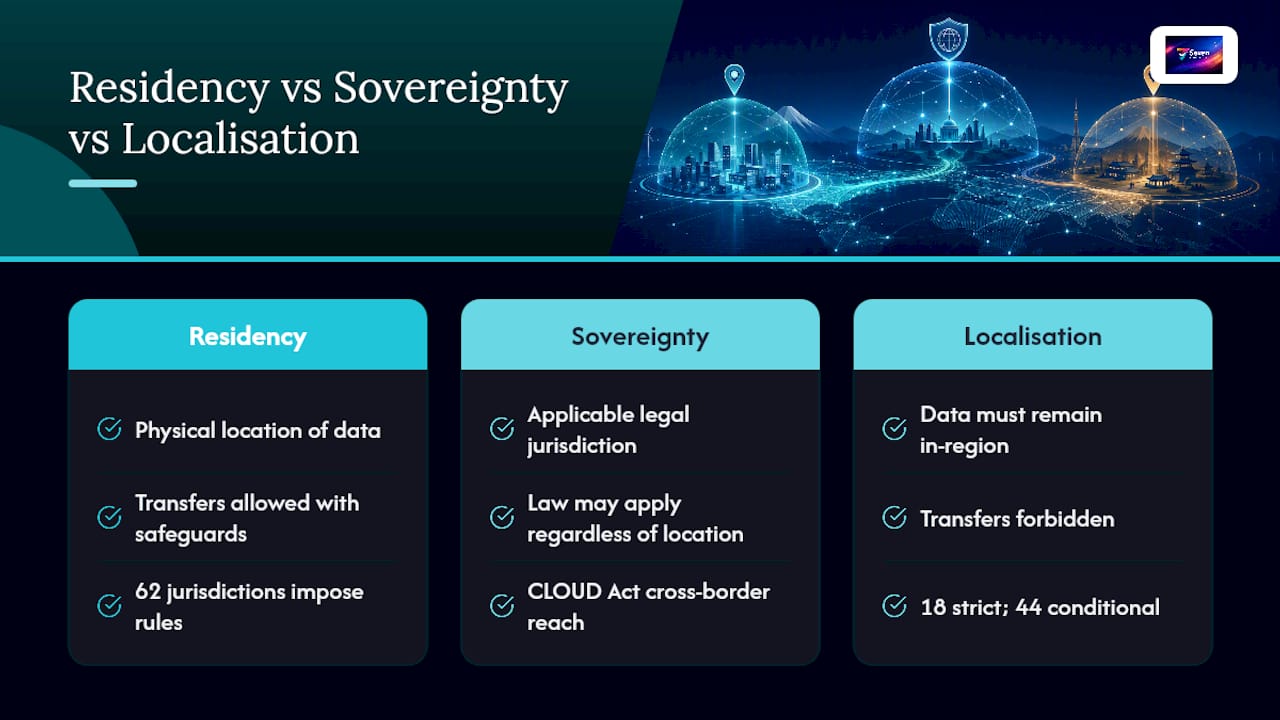
These three terms get used interchangeably, and that’s where SaaS teams get into trouble. Data residency is about physical location: which data centre or region holds the bytes. Data sovereignty is about legal jurisdiction: whose laws apply to that data, regardless of where it sits. A dataset stored in Frankfurt can still be subject to US law if a US-headquartered provider operates the infrastructure, which is exactly the scenario the CLOUD Act creates. Data localisation is the strictest of the three: it doesn’t just require data to sit in a region, it forbids that data from leaving, full stop.
This distinction matters because residency rules often permit cross-border transfers under safeguards like adequacy decisions, Standard Contractual Clauses, or Binding Corporate Rules. Localisation regimes don’t offer that flexibility.
By 2026, 62 jurisdictions impose some form of localisation or residency requirement, and 18 of those run strict localisation models with no transfer safeguard available. The remaining 44 use conditional approaches. Schrems II reinforced this problem for European data specifically, ruling that SCCs alone aren’t always sufficient, and forcing supplementary technical measures like encryption where government access risk is high.
Which countries have the strictest data residency requirements?
Expansion planning gets easier once you stop treating every country as a unique puzzle and start grouping them by pattern. Most jurisdictions fall into one of three buckets: strict localisation, conditional transfer, or largely unregulated.
Sector adds another layer on top of geography. Financial services regulators (India’s RBI, for instance) frequently mandate in-country storage for payment data regardless of the general national policy. Health data faces similar sector-specific overlays in many jurisdictions, often stricter than the general data protection regime. Telecoms and government contracts routinely carry residency riders that consumer SaaS never encounters.
| Jurisdiction type | Typical model | Transfer mechanism available |
|---|---|---|
| European Union | Conditional | Adequacy decisions, SCCs, BCRs |
| China | Strict localisation | Security assessment for cross-border transfer |
| Russia | Strict localisation | None for personal data of citizens |
| India (general) | Conditional, sector exceptions | Contractual safeguards, sector rules apply |
| United States (sector) | Largely unregulated federally | Sector-specific rules (health, finance) |
Adequacy decisions work like a trusted-country list: the EU has decided certain jurisdictions offer “essentially equivalent” protection, so transfers there need no extra paperwork. SCCs are the fallback for everywhere else, a standardised contract clause pair that binds both parties to EU-level obligations. BCRs suit large multinational groups moving data internally across their own entities. None of these mechanisms help you in a strict localisation regime. There, the only option is to keep the data in-country, full stop.
Why does ignoring data residency get expensive fast?
Procurement teams at large enterprises now ask residency questions before they ask about uptime SLAs. Get the answer wrong, and the deal doesn’t stall, it disappears from the pipeline entirely, often without you ever hearing why.
Sector-specific enforcement adds real financial risk. Health and financial data attract the strictest localisation demands precisely because regulators treat breaches in these categories as higher stakes, and penalty regimes reflect that.
The subtler cost is the retrofit. Building a single-region SaaS platform is cheap. Bolting regional isolation onto it two years later, once you’ve got shared logging pipelines, a unified analytics warehouse, and support tooling that reads across every tenant, is not. Teams end up duplicating infrastructure they never designed to be duplicated, running parallel support processes, and carrying the engineering overhead of two codepaths where one used to work fine. That’s technical debt with a compliance deadline attached, which is the worst kind.

How do you design SaaS architecture to prevent residency failures?
The fix isn’t duplicating your whole stack per region. It’s resolving residency once, early, and letting that decision propagate everywhere downstream.
- Resolve tenant region at the start of the request lifecycle. Once a request enters a shared processing pipeline, you’ve usually already lost residency control. Attach the region at the identity or session layer, before data touches storage or compute.
- Pin the region across storage, compute, logging, and backups together. Most compliance failures don’t happen in primary storage. They happen in the adjacent paths: a shared logging service, a centralised backup job, a support tool with global read access.
- Choose logical or physical isolation deliberately. Logical isolation (region-tagged rows in a shared multi-tenant database) is cheaper to run but harder to audit convincingly. Physical isolation (separate infrastructure per region) costs more upfront but gives you a much simpler compliance story when a regulator or a customer’s auditor comes asking.
- Layer in customer-managed keys and regional key stores. This is one of the higher-leverage moves available: regionally-scoped encryption keys can make compelled disclosure under a foreign law technically infeasible without your cooperation, which materially changes your exposure to CLOUD Act style requests.
- Consider edge-first processing for the hardest cases. Processing data in-jurisdiction with zero persistence, or using federated analytics that aggregate insights without moving raw data, satisfies strict localisation while still giving you cross-region visibility where you need it.
Pro Tip: Don’t localise everything by default. Classify your data first, because not every dataset needs the same treatment, and blanket duplication is the single most expensive mistake teams make when panicking about residency.
What should you demand from vendors and subprocessors?
Your own residency posture is only as strong as your weakest subprocessor. A payment gateway, an email delivery service, or an analytics tool that replicates data outside the agreed region can undo everything your own architecture got right.
Five questions belong in every vendor security review:
- Where is data stored primarily, and where are the backups?
- What’s the disaster recovery region, and does it match the primary?
- Who can access customer data for support purposes, and from where?
- What subprocessors do they use, and where are those subprocessors located?
- What happens to data on contract termination, and how quickly?
| Contract element | What reasonable buyer language looks like |
|---|---|
| Primary storage location | Named region, not “EU or equivalent” |
| Backup and DR alignment | Explicit commitment matching primary region |
| Subprocessor changes | Advance notice period, not silent updates |
| Support access | Documented access controls, not blanket global access |
| Audit evidence | SOC 2 scope covering the specific region, not just headquarters |
Ask for evidence, not assurances. Region-specific access logs, failover test results, and an up-to-date subprocessor list are the artefacts that hold up when a customer’s own auditor asks you to prove your vendor’s claims.
How do you monitor data residency once it’s implemented?
Compliance at launch doesn’t stay compliance. A new feature, a well-intentioned logging change, or a subprocessor’s own infrastructure migration can quietly move data out of region months later, with nobody noticing until an audit.
Data Security Posture Management (DSPM) tooling closes that gap. DSPM platforms continuously discover and classify live data flows, catching shadow copies, misconfigured replication, and out-of-region processing that a one-time architecture review would never surface.
Build these into your operating rhythm:
- Automated alerts on any data movement crossing a region boundary.
- Change control review specifically flagging residency-relevant infrastructure changes.
- Scheduled failover tests, with the results kept as audit evidence, not just a passed/failed note.
Pro Tip: Treat failover test results as compliance artefacts, not just engineering health checks. The auditor asking “prove your DR region matches your stated residency” wants exactly that document.
How does Seven approach data residency and privacy by design?
Seven is built by an independent team with no data mining and no selling of usage analytics, a structural choice that removes an entire category of residency risk before it starts. You can’t leak data through an analytics resale pipeline that doesn’t exist.
What Seven commits to, and what you can verify directly:
- Full data ownership with no vendor lock-in, so your project data stays exportable at any time.
- No AI training on customer data and no analytics-for-sale model.
- Transparent architecture you can check against the security and compliance page rather than taking on faith.
Verification is straightforward: read the security documentation, check the pricing and contract terms, and run your own evaluation during the trial period before committing.
What conventional data residency advice gets wrong
Most residency advice treats this as a legal problem that engineering implements after the fact. That’s backwards, and it’s why so many SaaS teams end up duplicating infrastructure under deadline pressure instead of designing for it from day one.
The overrated fix is geographic duplication as a default response. Spinning up a full regional stack for every jurisdiction you sell into is expensive, and in most cases unnecessary, because not every customer needs the strictest possible controls. The underrated fix is classification discipline: work out which data actually triggers a residency obligation before you build anything, then design the narrower set of controls that data actually requires.
The advice I’d push back on hardest is treating this as a compliance checkbox exercise finished at launch. Residency drifts. A logging change, a new analytics integration, or a subprocessor’s own infrastructure decision can quietly break your posture months later. Continuous monitoring through DSPM tooling isn’t optional maturity, it’s the only way regional pinning stays true over time.
If you’re building or retrofitting a SaaS platform right now, start with tenant-region resolution at the request layer. Everything else, backups, logging, key management, becomes far simpler once that one decision is made correctly and early.
— Greg
Where Seven fits if privacy and control are non-negotiable
Seven is the project management option for teams who want a straightforward answer to “where is my data stored and who else can see it”: nowhere you haven’t agreed to, and no one running analytics on it behind your back.
If you’ve read this far, you already know the alternative to architecture-first residency planning is retrofitting under pressure, which is expensive and slow. Seven was built by an independent team with no analytics resale model and no AI training on your project data, which means there’s no hidden pipeline moving your information somewhere you didn’t authorise. You get flexible workspaces, team collaboration, built-in messaging, and file attachments, all exportable on your terms with no vendor lock-in. Pricing is transparent at $5 for individuals and $9 per user for teams, with no hidden costs buried in a contract addendum. Start the 7 day free trial and check the security commitments yourself before you decide.
Sources
For primary legal detail, consult GDPR Chapter V on transfer mechanisms and the Teradata guide on residency across backup and DR lifecycles.
- Data residency in 2026: why where your data lives is now a legal and security problem | Layer27
- Data residency by design: how to address global compliance for scaling SaaS | Alation