Compliance Teams: Data Residency vs Sovereignty: Close Gap in 30 Days

Data sovereignty determines which country’s laws govern your data, no matter where the servers sit. Data residency determines only where the data physically lives. A file stored in a Frankfurt data centre still complies with Australian sovereignty rules only if the legal framework, not just the geography, lines up, and storing it locally is never enough on its own.
TL;DR:
- Ensuring compliance requires assessing both where data is stored and which governments can legally access or compel disclosure of that data.
- Tech controls like customer-managed encryption keys and strict access management are essential to maintaining sovereign control over data, beyond just local storage.
- Legal jurisdictions like the EU, US, and Australia have extraterritorial laws (such as the CLOUD Act) that can override data residency measures.
- Many organizations overlook sovereignty risks by focusing only on data residency, risking foreign disclosure obligations and regulatory penalties.
- Sovereignty strategies should be embedded into product design and vendor assessment from the start, not treated as a last-minute compliance checkbox.
Table of Contents
- Data residency vs sovereignty: the core definitions
- Data sovereignty vs residency: why the difference trips people up
- Legal implications and jurisdictional examples
- Technical controls and sovereign cloud options
- A practical checklist for closing the sovereignty gap
- Why product design matters more than most compliance checklists admit
- The gap nobody’s contract discloses
- Sources
Data residency vs sovereignty: the core definitions
Getting these terms straight matters because legal teams, security leads, and cloud architects often use them interchangeably, and that habit creates real compliance gaps.
Data residency is the physical or geographical location where data is stored and processed. It’s about the address: a specific cloud region, a named data centre, or the country where your backups replicate to. If your provider commits to keeping customer data in Sydney, that’s a residency commitment.
Data sovereignty extends further. It covers which government’s laws and regulations apply to that data, regardless of where it physically sits. AWS’s own explainer puts it plainly: residency is about location, sovereignty is about the legal jurisdiction that has authority over the data. A company incorporated in the United States can still be compelled to hand over data stored in Ireland, because sovereignty follows the operator’s legal exposure, not just the server rack.
Data localisation sits between the two. It’s a specific regulatory requirement, sometimes mandated by law, that data must stay within a country’s borders and never leave, which is stricter than voluntary residency and narrower than the broader sovereignty question.
- Residency: where the data is stored
- Sovereignty: whose laws apply to it
- Localisation: a legal mandate forcing residency and sovereignty to align
Data sovereignty vs residency: why the difference trips people up
The most common mistake is treating “we host in-region” as proof of compliance. It isn’t. Here’s what actually separates the two concepts in practice:
- Scope. Residency answers a geography question. Sovereignty answers a legal one, covering ownership, access rights, and enforcement.
- Who can compel access. A government can often demand data from any provider legally domiciled or operating within its borders, even when the servers sit offshore.
- Technical vs legal control. Encryption and region locking are technical levers. Sovereignty is decided in courtrooms and legislation, not in a cloud console.
- Enforcement reach. Sovereignty claims can be extraterritorial. A local storage location doesn’t insulate you from a foreign government’s subpoena power if the operator answers to that government.
- Support and operations. Sovereignty also considers who can log into the system, not only where the disks spin. A support engineer in another country with admin access is a sovereignty exposure even when the data itself never leaves its home region.
Two examples make this concrete. First, a business hosts customer data in a local cloud region, but the provider is incorporated in a foreign jurisdiction with broad disclosure laws, so the data can still be compelled offshore despite never physically leaving. Second, a company stores everything in-region but outsources support to an overseas team with standing access to production systems, creating a sovereignty gap that a residency audit alone would never catch.
Pro Tip: When you assess a vendor, ask two separate questions: “Where is my data stored?” and “Which governments can legally compel this company to disclose it?” If the answers point to different countries, you have a sovereignty problem, not just a residency box to tick.
Legal implications and jurisdictional examples
Sovereignty rules rarely stay inside one border, and that’s where most compliance surprises happen.
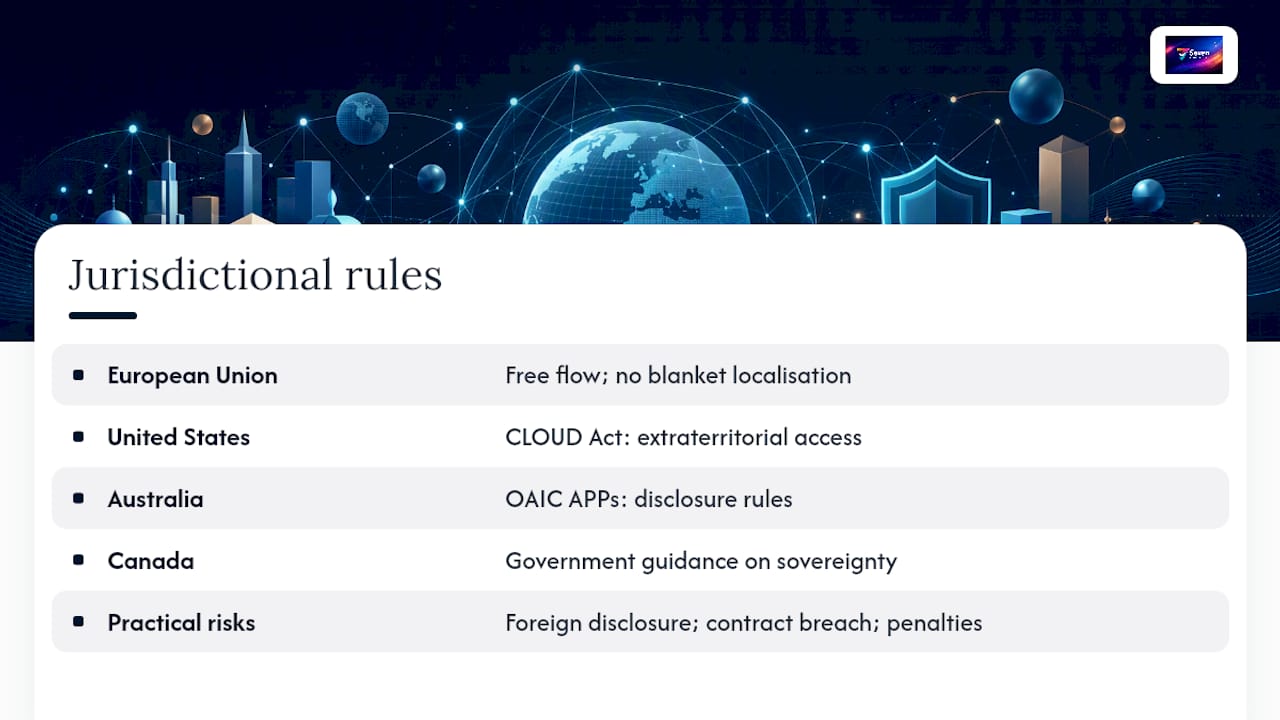
The European Union generally favours the free flow of non-personal data across member states and prohibits blanket data localisation mandates unless justified on public security grounds, according to Regulation (EU) 2018/1807. That regulation also clarifies what competent authorities can expect in terms of access, which matters if you’re negotiating a contract with a provider operating across the bloc.
In the United States, the CLOUD Act can require providers incorporated or operating under US law to respond to law enforcement data requests, even when that data sits in a data centre outside American territory, per the CLOUD Act overview. This is the clearest illustration of extraterritorial reach: US jurisdiction can follow a US company’s infrastructure anywhere on the planet.
In Australia, the OAIC’s Australian Privacy Principles form the primary regulator guidance for privacy obligations, and they’re the first stop for assessing local sovereignty-related expectations, including cross-border disclosure rules.
Canada has published its own digital sovereignty guidance through government cloud strategy papers, reflecting a growing pattern: national governments are formalising sovereignty policy separately from privacy law, treating it as an infrastructure and national security question as much as a data protection one.
Organisations face three practical risks when sovereignty and residency misalign: unexpected foreign disclosure obligations, contractual breach if a client mandate specified sovereign, not just resident, data, and regulatory penalties when a data-flow map doesn’t match what a regulator finds during audit. Industry guidance from IBM notes that where data was originally collected, and which legal entity operates the infrastructure, both influence which laws ultimately apply, not just where the bytes rest today.
Technical controls and sovereign cloud options
Full sovereignty rarely requires full localisation. It requires the right combination of technical and contractual controls layered on top of sensible residency choices.
Sovereign cloud options run on a spectrum. At one end, you get a local region operated by local staff under local legal domicile. At the other, you get audited controls layered onto a global provider’s infrastructure, with contractual guarantees standing in for full operational independence. Acronis’s analysis for service providers makes the point directly: sovereign cloud needs local operational control, not merely local storage.
The technical toolkit includes:
- Customer-managed encryption keys, so the provider can’t decrypt data even under legal pressure without your cooperation
- In-region key stores or key escrow, keeping the cryptographic control plane inside the same jurisdiction as the data
- Split architectures that separate metadata, application logic, and raw storage across different trust boundaries
- Strict identity and access management that limits which staff, in which countries, can ever touch production systems
Operationally, look for local support teams, explicit contractual commitments on data handling, audit rights written into the agreement, and regular transparency reporting on government access requests. Our internal breakdown of data residency in SaaS architecture covers how vendors structure these commitments in practice.
Pro Tip: Ask any SaaS vendor for their data-flow diagram before you sign, not after. If they can’t produce one showing where data lands and who can access it at each hop, that’s your answer about how seriously they treat sovereignty.
The trade-offs are real. Sovereign architectures often add latency, cost more to operate, and complicate vendor relationships because every audit and every access request needs documenting.
A practical checklist for closing the sovereignty gap
Run this as a sequential project, not a one-off audit. Most mid-sized organisations can complete the first three steps within 30 days.
- Map your data. Classify every dataset by sensitivity and by which jurisdictional triggers apply, customer location, data type, and regulatory category.
- Run the legal review. Identify exactly which laws apply to each dataset, including where your provider is incorporated and where support staff sit.
- Assess your providers. Check operational control, legal domicile, key management practices, and support access, not just the advertised storage region.
- Choose your controls. Decide between contractual guarantees, technical measures, or true localisation based on risk tolerance, then estimate the implementation timeline and cost realistically, since full sovereign infrastructure can take months to stand up.
- Build monitoring and audit readiness. Set up breach response procedures and keep audit evidence current, because confusing residency for sovereignty creates a false sense of compliance that only surfaces during an actual incident or regulator review.
Teams that skip step 3, provider assessment, are the ones most often blindsided when a foreign disclosure request lands on a vendor they assumed was purely local.
Why product design matters more than most compliance checklists admit
Most sovereignty problems start with a contract, not a server. If your vendor mines your data, sells analytics, or locks your exports behind proprietary formats, you’ve already lost a layer of control that no amount of regional hosting fixes.
The platform was built around a simpler premise: your project data belongs to you, full stop. No analytics resale, no AI training on your workspace content, and Excel import and open data export mean you’re never trapped by a format you can’t leave. That’s not a sovereignty guarantee in the legal sense, but it removes an entire category of exposure that heavier platforms create by default. If you’re building a sovereignty strategy, product-level choices like these belong in your provider assessment, right alongside jurisdiction and key management. You can see Seven’ pricing and trial terms if you want to test that approach against your own checklist.
The gap nobody’s contract discloses
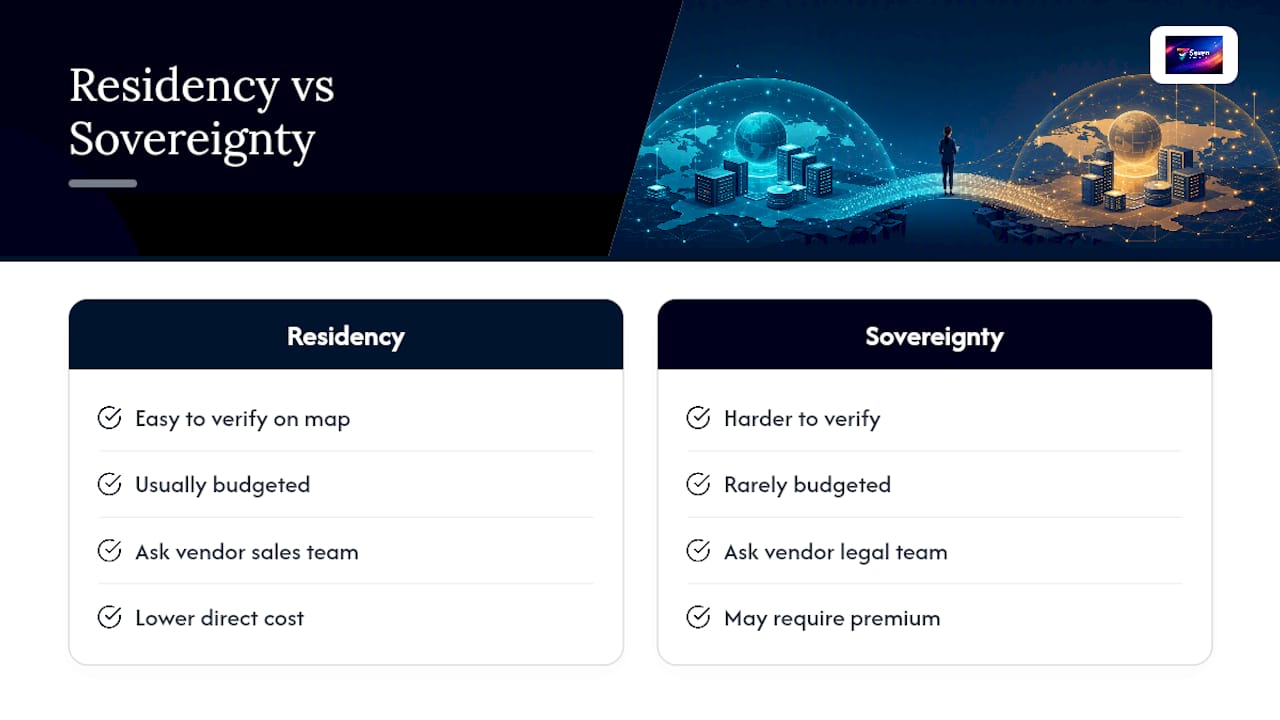
Here’s what fifteen years of watching compliance teams get this wrong has taught me: everyone budgets for residency because it’s easy to verify, you can literally point at a data centre on a map, and almost nobody budgets for sovereignty because it’s uncomfortable. It requires asking your vendor’s legal team, not their sales team, who can compel disclosure and under what conditions.
The conventional wisdom says “choose the right region and you’re compliant.” That’s backwards.
I’d also push back on the assumption that sovereign cloud always means paying a premium for a fully isolated stack. In plenty of cases, combining in-region storage with customer-managed keys and solid contractual terms gets you 90% of the protection at a fraction of the cost and timeline of a bespoke sovereign deployment. The organisations that get this right treat sovereignty as a design constraint from day one, not a certification they bolt on after a client asks an awkward question during procurement.
— Greg
Sources
- What is Data Sovereignty? - AWS
- Regulation (EU) 2018/1807 on a framework for the free flow of non-personal data
- Australian Privacy Principles - OAIC
- Data sovereignty versus data residency: What’s the difference? - IBM