Stop Vendor Lock In With a SaaS Vendor Due Diligence Scorecard

Run SaaS vendor due diligence with a compact checklist paired with a weighted scorecard, and tier how hard you dig by data sensitivity and contract value. Start with three checks before anything else: can the vendor survive the next 18 months, can you get your data out on reasonable terms, and does the contract let you leave without being punished for it.
TL;DR:
- Most vendors should demonstrate a minimum 18-month runway, a recent SOC 2 Type II report, and a clear exit strategy in their contractual terms.
- Verification of data residency, comprehensive export scope, and explicit ownership clauses are essential for avoiding lock-in risks in SaaS contracts.
- Security assessments must include recent penetration test summaries, encryption standards, and breach notification timelines, not just compliance certificates.
- Integration checks should involve reviewing actual API documentation and conducting pilot tests to identify potential implementation delays.
- Due diligence timelines vary from 2-3 days for low-risk tools to 2-4 weeks for critical, regulated, or high-value SaaS solutions.
Table of Contents
- What does SaaS vendor due diligence actually involve?
- Vendor evaluation scorecard: how to turn evidence into a defensible decision
- How do you check a SaaS vendor’s financial viability?
- Security posture and compliance evidence to demand and how to read it
- Data handling, residency and export: what to lock in contractually
- Key contract clauses to negotiate before you sign
- What support and operational resilience should you expect?
- API and integration reality checks before you commit
- Pricing transparency: modelling the real total cost of ownership
- What’s a realistic timeline to run SaaS vendor due diligence?
- Seven’s approach to data ownership: what to ask any vendor to match
- What actually separates good diligence from box-ticking
- Where to go for templates and deeper reference material
- Sources
- FAQ
What does SaaS vendor due diligence actually involve?
SaaS vendor due diligence is the structured process of verifying a vendor’s financial stability, security posture, contractual terms, and operational capacity before you sign, renew, or acquire. It’s not a procurement formality. It’s risk management dressed up as a spreadsheet, and most buyers still run it backwards, starting with a feature demo and treating financial and legal checks as an afterthought once the sales relationship has already built momentum.
The standard industry term for this exercise is vendor due diligence (sometimes shortened to VDD), and it borrows heavily from M&A practice: financial, legal, operational, and technical review, compressed into weeks instead of months. For SaaS specifically, that means adding two domains legacy VDD frameworks never had to worry about: data portability and API-level integration risk. A vendor can pass every financial and legal check and still leave you stranded if your data can’t get out in a usable format.
Vendor evaluation scorecard: how to turn evidence into a defensible decision
A weighted scorecard exists to stop the loudest voice in the room from winning. Unscored evaluations tend to reward whoever demoed best or negotiated hardest, not whoever actually reduces risk. A weighted 1–5 scorecard limited to 6–10 criteria, with weights frozen before demos begin, forces every stakeholder to rate the same vendor against the same fixed yardstick.
Pass/fail gates matter as much as the weighting. A vendor can score brilliantly on usability and still fail outright if it can’t produce a current SOC 2 Type II report for a data-sensitive workload. Build those gates in before scoring starts, not after a favourite emerges.
Recommended categories and rough weight ranges:
- Functional fit (20–30%): does it solve the actual workflow problem, not just the demo scenario
- Security and compliance (15–25%): certifications, audit history, breach record
- Total cost of ownership (15–20%): full multi-year cost, not year-one pricing
- Vendor viability (10–20%): funding, customer concentration, growth trajectory
- Integrations and API maturity (10–15%): real endpoint coverage, not marketing claims
- Implementation effort (5–10%): migration complexity and time-to-value
- Usability and scalability (5–10% combined): adoption risk and headroom for growth
| Category | Suggested weight | What kills a score here |
|---|---|---|
| Functional fit | 20–30% | Core workflow needs custom workarounds |
| Security & compliance | 15–25% | No current SOC 2 Type II, vague breach history |
| Total cost of ownership | 15–20% | Hidden tier gating, surprise overage fees |
| Vendor viability | 10–20% | No funding update in 18+ months, concentrated customer base |
| Integrations/API | 10–15% | Thin documentation, low rate limits |
| Implementation | 5–10% | Migration timeline exceeds 90 days for mid-market scope |
Assign scoring by function: security scores security, finance scores viability, end users score usability. That division is what turns a scorecard exercise into a defensible governance record rather than a gut-feel decision with a spreadsheet attached.
How do you check a SaaS vendor’s financial viability?
Ask for the vendor’s funding stage and the date of its most recent raise before anything else. A private SaaS company that hasn’t closed a round in over 18 months without a credible profitability story is carrying real survival risk, and that risk becomes your risk the moment you’re dependent on their uptime.
The 18–24 month rule: seed and Series A vendors should show 18–24 months of runway, or be able to explain, specifically, how they’re covering costs without burning cash indefinitely. If a vendor hasn’t progressed to a Series B within that window and can’t answer directly, that’s a prompt for harder questions, not a disqualifier on its own.
Beyond funding timing, check these signals:
- Customer concentration — if one customer represents more than 15% of annual recurring revenue, the vendor’s roadmap could bend to that customer’s needs at your expense, or collapse if that customer leaves
- Headcount trends — sudden layoffs, especially in engineering or support, often precede service quality drops well before financial trouble becomes public
- Growth signals — published customer counts, G2 or Capterra review velocity, hiring activity on LinkedIn
- Investor names — recognisable institutional backers usually signal a stronger diligence process than the vendor’s own claims
You’re not entitled to GAAP financial statements from a private company, and demanding them will usually just end the conversation. Reasonable questions instead: are you cash-flow positive, when did you last raise, and who are your lead investors? A vendor that dodges all three answers something too.
Security posture and compliance evidence to demand and how to read it
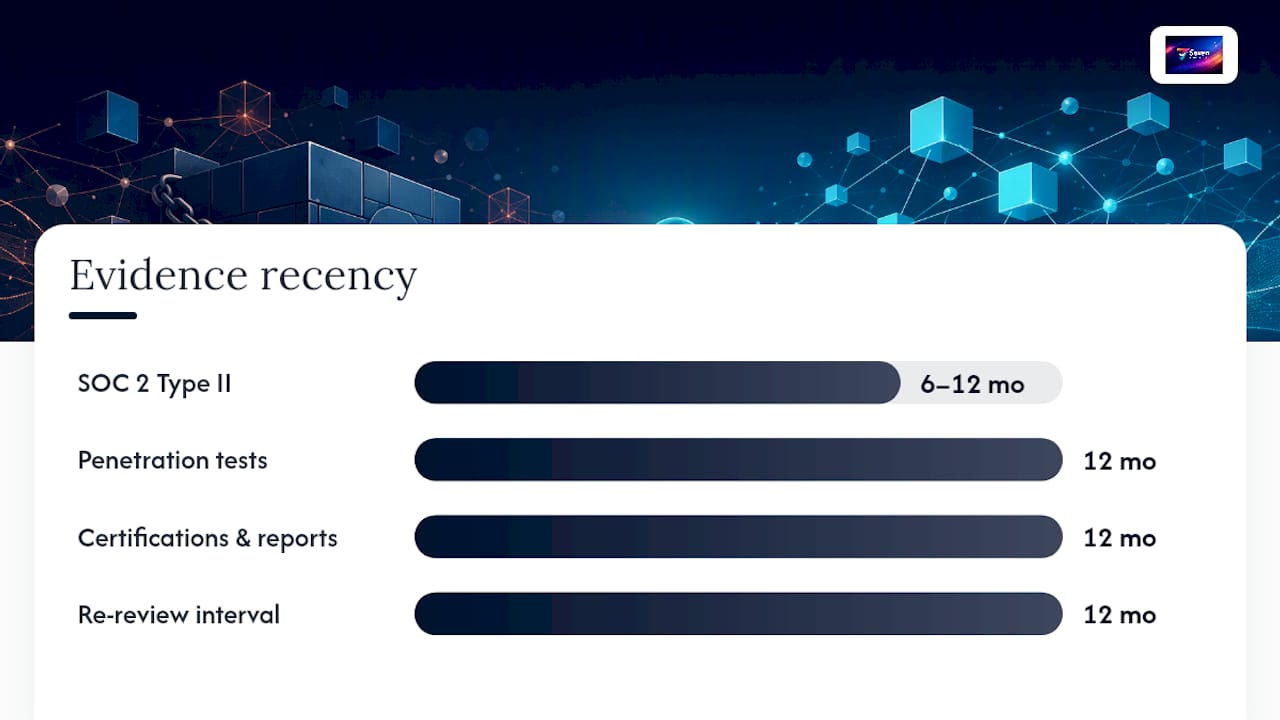
Any vendor touching sensitive data should produce a current SOC 2 Type II report before you sign anything. SOC 2 Type II demonstrates operating effectiveness of controls over a 6 to 12 month observation window, which is a materially stronger signal than SOC 2 Type I, which only checks whether controls exist on a single date. A vendor offering Type I as their top-tier evidence for a production, data-heavy workload is offering you a snapshot, not a track record.
Reading the report matters as much as requesting it. Check the observation period dates, look for the auditor’s name (a recognised firm carries more weight), and read the exceptions section closely. Every SOC 2 report has some exceptions; the question is whether they’re minor administrative gaps or something touching access control and encryption.
Beyond the SOC 2 report itself, request:
- Penetration test summaries from the last 12 months, ideally from an independent third party rather than internal red-teaming alone
- Encryption standards for data at rest and in transit, stated explicitly rather than as “industry-standard”
- MFA and SSO support, and whether SSO sits behind a higher pricing tier
- Subprocessor lists, so you know exactly who else touches your data downstream
- Breach-notification timelines, written into the contract, not just described verbally
Enterprises increasingly expect these reports to be current within the last 12 months, and an expired or stale certification is weak evidence for anything running in production.
Pro Tip: A vendor that refuses to share a SOC 2 summary under a signed NDA is not protecting a trade secret. NDAs exist precisely for this scenario. Treat that refusal as the red flag it is, not a quirk of their legal team.
Watch for vague answers about whether customer data trains AI models. That question should have a clean, specific answer. If it doesn’t, assume the answer is yes and act accordingly. Security evidence is also a point-in-time snapshot, so schedule a re-review annually or whenever a certification renews, particularly for vendors classified as business-critical.
Data handling, residency and export: what to lock in contractually
Confirm where your data physically lives before you confirm anything else about the platform’s features. Data residency options, encryption standards in transit and at rest, and the vendor’s full subprocessor list should all be documented, not described in a sales call and forgotten.
Export terms deserve more scrutiny than most buyers give them. A vendor might happily export your task records while leaving metadata, audit logs, and file attachments behind, and you won’t discover the gap until you’re already migrating under pressure. Specify export scope in writing:
- Full record export, not just the primary data objects
- Metadata and audit logs, which matter enormously if you’re in a regulated industry
- A defined export SLA, typically 30 to 60 days from request to delivery
- Export format, ideally something portable like CSV or JSON rather than a proprietary binary
Contract language should also cover data ownership explicitly (you own it, not the vendor), certified deletion after termination (with a written confirmation, not just an assurance), and a post-termination access window, so you’re not locked out the day your contract ends. Operational reality checks around export completeness and identity-feature gating catch far more real-world risk than a feature checklist ever will. Lock-in rarely announces itself. It shows up eighteen months later as a vendor quoting a six-figure “data extraction fee” you never saw coming, which is exactly the scenario a clear exit clause is designed to prevent.
Key contract clauses to negotiate before you sign
The contract is where most of the real risk transfer happens, and it’s the section buyers rush through fastest because legal review feels like the last step rather than a diligence domain in its own right.
- SLA measurement and credits. Define uptime measurement precisely, specify service credits for breaches, list exclusions (planned maintenance, force majeure), and push for automated credit issuance rather than a manual claims process nobody follows through on.
- Liability caps and indemnities. Caps should scale with contract value; a vendor capping liability at one month’s fees on a seven-figure annual contract is offering you almost nothing if something goes wrong. Ask what insurance they carry, specifically cyber liability, and at what coverage level.
- Auto-renewal windows. Insist on a minimum 60 to 90 day notice period before auto-renewal locks you in for another term, longer for multi-year commitments.
- Price escalation caps. Cap annual price increases at a fixed percentage, ideally tied to a published index rather than left to the vendor’s discretion at renewal time.
- Termination for convenience. Even a modest early-termination fee is preferable to no exit option at all, particularly for anything beyond a 12-month term.
- Post-termination data access. Define exactly how long you retain access after termination and under what conditions, in writing, not as a verbal promise from your account manager.
None of these clauses cost the vendor much to grant if they’re negotiating in good faith. Resistance on any of them tells you something about how they expect the relationship to end.
What support and operational resilience should you expect?
Support quality is invisible until the moment you need it, which is exactly why it belongs in diligence rather than being discovered during your first production outage.
Ask for the actual SLA structure by severity level, not a general “we respond quickly” assurance. A credible vendor will state response time and resolution time separately, because those are different commitments; responding to a critical ticket in 30 minutes means little if resolution routinely takes three days.
- Support hours and coverage — 24/7 for anything business-critical, business-hours-only is a real limitation for global teams
- Named contact versus queue — a named customer success manager for larger accounts usually resolves issues faster than anonymous ticket queues
- Escalation path clarity — ask them to walk you through exactly what happens when a P1 incident hits, not just what the SLA document says
- Incident transparency — check their public status page history and whether past outages were communicated proactively or discovered by customers first
For anything running in production, insist on seeing runbooks, on-call contact structures, and third-party continuity plans, particularly if the vendor itself depends on a single cloud region or a single subprocessor for critical infrastructure.
API and integration reality checks before you commit
Vendor sales decks describe integrations in absolutes. Reality is usually messier, and the gap between the two is where implementation timelines blow out.
- Read the actual API documentation, not the marketing page describing it. Check endpoint coverage against your specific use case, rate limits under real load, and whether webhooks exist or you’re stuck polling.
- Distinguish native connectors from partner-maintained ones. A native Salesforce integration built and owned by the vendor behaves very differently from one maintained by a third party who might deprioritise fixes.
- Run a real pilot before committing. Test an actual data export, map your critical fields against the vendor’s schema, and time how long it genuinely takes to reach first value, not the vendor’s estimate of it.
Integration debt compounds. A vendor with thin API documentation today usually has thin documentation next year too.
Pricing transparency: modelling the real total cost of ownership
List price is the least useful number in any SaaS negotiation. The real cost lives in tier gating, seat minimums, overage fees, and what happens at renewal, none of which show up on the pricing page.
- Tier requirements — confirm which features are locked to higher tiers before you calculate a per-seat cost, since SSO, advanced permissions, and audit logs are frequently gated behind enterprise pricing
- Seat minimums and add-on costs — some vendors quote attractive per-seat pricing that only applies above a minimum seat count you didn’t anticipate
- API and storage overages — model realistic usage, not the vendor’s optimistic baseline scenario
- Implementation and training costs — get these itemised separately from subscription fees, since they’re often where budgets quietly blow out
- Renewal uplift — ask directly what price increase to expect at renewal, and try to cap it contractually rather than discovering it a year later
Pro Tip: Negotiate the second-year price before you sign the first-year contract. Vendors offer generous year-one discounts precisely because switching costs make year-two increases easy to swallow once you’re already dependent on their platform.
A third-party cost and security review, like the kind offered through Cost Beacon, can benchmark your shortlisted vendor’s TCO and security posture against comparable tools before you commit budget.
What’s a realistic timeline to run SaaS vendor due diligence?
Effort should scale with what’s actually at stake, not run at one fixed intensity regardless of contract size. Mid-market purchases under roughly US$10,000 a year warrant a lighter pass; anything above US$100,000 annually deserves a formal security questionnaire and full legal review.
- Quick pass (2–3 days): low-risk, low-spend, non-data-sensitive tools. Scorecard review plus a basic security questionnaire, no formal legal sign-off required.
- Standard pass (7–10 days): typical mid-market SaaS spend. Full scorecard, SOC 2 review, two reference calls, and a contract redline pass from legal.
- Deep pass (2–4 weeks): business-critical or regulated-data vendors. Add a penetration test summary review, formal security questionnaire, financial viability check, and a documented steering decision with sign-off from every function involved.
Assign roles clearly: security/IT owns the SOC 2 and penetration test review, procurement runs the scorecard and negotiates commercial terms, finance checks viability, product and end users score usability and functional fit, and legal reviews the contract. One person should own the final decision gate, so the process doesn’t stall waiting for consensus that never fully arrives.
Seven’s approach to data ownership: what to ask any vendor to match
Seven treats customer data ownership as a design principle rather than a legal afterthought. The platform is built to avoid vendor lock-in entirely, with open data export that lets teams take their task records, boards, and file attachments out in usable formats whenever they choose, without a support ticket standing between them and their own information.
That’s the standard worth holding every vendor to during diligence. Ask specifically whether workspace separation exists so your data isn’t commingled with another customer’s in ways that complicate export later. Ask whether export includes attachments and metadata, not just the primary task records, and whether the vendor mines your data for analytics or AI training.
Seven’s security and compliance documentation is a useful reference point for the kind of specificity buyers should demand from any SaaS vendor, not just Seven itself. The contract clauses to request follow directly from the product behaviour: written confirmation of data ownership, a defined export format and timeline, and no penalty for leaving. If your current vendor evaluation process for teams weighing Excel imports and flexible workspace tools against heavier enterprise platforms needs a benchmark for what “no lock-in” should actually look like in a contract, Seven’s public terms are a reasonable place to start, and teams can trial that approach directly before comparing it against anything else on the shortlist.
What actually separates good diligence from box-ticking
The conventional wisdom treats security certifications as the finish line. They’re the starting point. A SOC 2 Type II report tells you a vendor had adequate controls during a specific observation window, not that those controls will hold in eighteen months, and not that the company itself will still exist to maintain them.
If I had to compress this whole process into one instinct, it’s this: weight exit rights and vendor viability heavier than feature comparisons, especially for early-stage vendors and multi-year commitments. Features get replicated. A vendor going quiet on funding, or a contract with no defined export SLA, doesn’t get fixed by a good product team.
Demand evidence, not badges. A “SOC 2 compliant” claim on a website means nothing without the actual report and a look at its exceptions. Freeze your scorecard weights before the first demo, document why you scored what you scored, and keep that record. Eighteen months from now, when someone asks why you picked this vendor, “it felt right” is not going to hold up in a governance review, and a scored, dated rationale will.
— Greg
Where to go for templates and deeper reference material
For a ready-made scoring template and weighting guidance, start with the SaaS vendor evaluation scorecard. For financial viability and reference-check scripts specifically, the pre-purchase vendor diligence checklist covers both in useful detail. On security artefacts, the SaaS vendor security assessment guide explains what a SOC 2 Type II report should actually contain. Keep every SOC 2 report a vendor shares under NDA on file. You’ll want it again at renewal.
This article is general information, not a substitute for advice from a qualified financial advisor. Consult a qualified financial professional about your own circumstances before acting on anything here.
Sources
Vendor-provided references trend positive by design, because vendors choose who you talk to. Independent reference checks reveal more, particularly ones sourced through your own professional network rather than the vendor’s curated list.
- SaaS vendor evaluation scorecard
- SaaS vendor security assessment: 2026 buyer’s guide
- The 2026 SaaS vendor due diligence checklist
A reference who hesitates before answering has usually told you more than the one who answers instantly.
FAQ
What is included in vendor due diligence?
Vendor due diligence covers financial viability, security and compliance evidence, contract terms, data portability, integration maturity, and support capability, typically assessed through a weighted scorecard and documented references.
What are the key components of a SaaS due diligence checklist?
The core components are financial stability (funding stage and runway), security certifications like SOC 2 Type II, data residency and export terms, contract clauses covering SLA and termination, integration and API quality, and total cost of ownership.
What are the “four P’s” of due diligence?
Definitions vary across industries, and there’s no single standardised “four P’s” framework specific to SaaS vendor due diligence. Treat any version you encounter as one interpretation rather than an industry standard, and rely on the domain-specific checklist covered above instead.
What is a red flag DD report?
A red flag due diligence report is a condensed review that surfaces only the most material risks, such as customer concentration above 15% of revenue, an expired SOC 2 certification, or unfavourable termination terms, without the full depth of a complete diligence process.
How long should SaaS vendor due diligence take?
A quick pass for low-risk tools takes 2 to 3 days, a standard mid-market review takes 7 to 10 days, and a deep review for business-critical or regulated-data vendors takes 2 to 4 weeks.