Seven Privacy by Design Principles Mapped to Engineering Backlogs

Privacy by design means building privacy protections directly into systems, defaults, and processes from the first line of code, rather than bolting them on after launch. Done properly, it cuts breach exposure, lowers the cost of fixing privacy gaps later, and helps maintain alignment with regulations like the GDPR. This article breaks the seven founding principles into engineering tasks, shows you how to run a proper privacy impact assessment, and points to the tools that make traceability manageable.
TL;DR:
- Building privacy protections from the start reduces costs and minimizes exposure, especially if privacy is embedded into data models and automatic deletion is implemented.
- Privacy by design principles are operationalized through technical patterns like data minimization, encryption, role-based access, and continuously updated privacy impact assessments.
- Proper implementation requires clear ownership, integration into existing workflows, and regular updates, rather than treating privacy as a one-time compliance check.
- Regulatory compliance, especially under GDPR and similar laws, demands demonstrable artefacts such as privacy impact assessments, control matrices, and evidence of technical safeguards.
- Emerging technologies and automation are making continuous risk assessment and AI-specific privacy considerations more feasible, emphasizing the importance of a dedicated privacy owner.
Table of Contents
- What is privacy by design and why do organisations adopt it?
- The seven foundational principles, explained for engineering teams
- How to implement privacy by design in technology projects
- Privacy impact assessments: purpose, scope and getting them right
- Mapping privacy by design to regulation and standards
- End-to-end data lifecycle protection
- Challenges and common pitfalls in implementing privacy by design
- Integrating privacy by design with security frameworks and risk management
- The role of organisational culture and training in supporting PbD
- Emerging trends and future directions in privacy by design
- Author perspective: starting PbD in your organisation
- How Seven supports privacy-first teams
- Sources
- FAQ
What is privacy by design and why do organisations adopt it?
Privacy by design was formalised by former Ontario Information and Privacy Commissioner Ann Cavoukian in the 1990s, and it treats privacy as something engineered across the entire data lifecycle, from collection through to deletion, not a compliance checkbox added at the end. The concept has since become embedded in global privacy frameworks, and it rests on a “positive-sum” idea: privacy and functionality aren’t opposing forces you trade off against each other.
Organisations adopt it for three practical reasons. Retrofitting privacy into a live system costs more than designing it in from day one, because you’re rewriting data flows instead of shaping them. Reduced data collection means less to protect, and less exposure if something goes wrong. And demonstrable privacy practice builds trust with customers and regulators alike.
In practice, this shows up as:
- Privacy-protective settings switched on by default, not buried in a settings menu
- Pseudonymisation or encryption applied to sensitive fields before they ever touch a database
- Automated data deletion once a retention period expires, rather than a manual cleanup job nobody owns
The seven foundational principles, explained for engineering teams
Cavoukian’s seven principles are often quoted but rarely translated into anything an engineer can action. Here’s what each one actually means for a sprint backlog.
- Proactive, not reactive. Identify privacy risks in the design phase, before a single API endpoint exists. In practice: privacy threat modelling sits alongside security threat modelling at the architecture review stage.
- Privacy as the default setting. Users get maximum privacy protection without lifting a finger. In practice: opt-in data sharing, not opt-out; minimal data collected on signup.
- Privacy embedded into design. Privacy isn’t a separate layer, it’s part of the core architecture. In practice: data models built around field-level access control from the outset.
- Full functionality, positive-sum. You don’t sacrifice usability for privacy. In practice: pseudonymised analytics that still answer product questions without exposing individual users.
- End-to-end security, full lifecycle protection. Data is protected from collection to deletion. In practice: encryption in transit and at rest, plus automated retention and deletion schedules.
- Visibility and transparency. Practices are open to independent verification. In practice: a public-facing data map, clear consent language, and audit logs that hold up under scrutiny.
- Respect for user privacy. The individual’s interests come first. In practice: self-service data export and deletion tools that actually work, not a support ticket that goes nowhere.
Alongside these, New Zealand’s Digital Government guidance sets out four operational design strategies worth adopting as a working vocabulary: minimise and separate (collect less, store it apart from other data), hide and abstract (mask identity where full detail isn’t needed), enforce and demonstrate (build policy into code and log proof of compliance), and inform and control (give users visibility and levers over their own data).
Pro Tip: Map each of the seven principles to a specific acceptance criterion in your backlog tool. If a principle can’t be tied to a testable requirement, it hasn’t actually been implemented, it’s still a slogan.
How to implement privacy by design in technology projects
Privacy by design fails when it’s treated as a document rather than a workflow. It succeeds when privacy requirements sit inside the same tools and rituals your team already uses for delivery.

Start at discovery. Every new feature that touches personal data needs a data-flow map before design work begins, showing what’s collected, where it’s stored, who can access it, and when it’s deleted. That map becomes the reference point for a privacy acceptance criterion written into the user story itself, not a separate compliance document nobody reads.
During development, four technical patterns do most of the heavy lifting:
- Data minimisation — collect only fields you have a genuine product reason to store
- Pseudonymisation and encryption — separate identity from behavioural data wherever possible, and encrypt sensitive fields at rest
- Granular access controls — role-based permissions so engineers debugging a system aren’t automatically viewing customer records
- Automated retention and residency rules — deletion schedules and storage location baked into infrastructure, not left to a quarterly manual audit
ENISA’s engineering guidance is a useful reference here for translating these patterns into architecture decisions rather than policy statements.
Operationally, keep your privacy impact assessment alive rather than static. Feed updates into sprint reviews, run privacy checks as release gates in your CI/CD pipeline, and maintain a requirements trace matrix linking each privacy control back to the principle or regulation it satisfies. That matrix is what you hand an auditor, and it’s what saves you scrambling to reconstruct decisions six months later. Vendor assessments deserve the same discipline: before adding a third-party service, check what it does with the data you’d feed it, and whether that aligns with your own data ownership commitments.
Privacy impact assessments: purpose, scope and getting them right
A privacy impact assessment (PIA), often called a data protection impact assessment (DPIA) under GDPR terminology, is a structured process for identifying and reducing privacy risks in a project before it goes live. Under most regulatory regimes, it becomes mandatory for high-risk processing, large-scale profiling, sensitive data categories, or systematic monitoring.
The OAIC frames PIAs as a lifecycle practice, not a one-off gate. A workable process follows five steps:
- Map the data flows: what’s collected, from whom, why, and where it travels.
- Assess the risk: likelihood and severity of harm if something goes wrong.
- Mitigate through design changes, not just documentation, actual architecture decisions.
- Assign ownership: a named person accountable for each identified risk.
- Update continuously as the system evolves, not annually as a formality.
The most common failure is treating the PIA as a checkbox exercise completed once and filed away. Some regulatory guidance is blunt about this: PIAs work best as strategic, living documents that get revisited every time the system changes materially, not static artefacts signed off before launch and never opened again. Integrating PIA updates into sprint cycles, rather than treating them as an annual compliance ritual, keeps the assessment honest.
Mapping privacy by design to regulation and standards
Article 25 of the GDPR turns “data protection by design and by default” from best practice into a legal requirement for any organisation processing personal data under EU or UK regimes. It requires appropriate technical and organisational measures at the time of determining processing means, not after the system is built.
The ICO’s guidance is clear that compliance needs demonstrable artefacts, not just good intentions. Reviewers typically look for:
- A completed PIA/DPIA for high-risk processing activities
- A requirements trace matrix linking technical controls to specific regulatory obligations
- Evidence of technical controls: encryption standards, access logs, retention schedules
- Vendor and third-party processor assessments showing due diligence
Regulatory expectations vary by jurisdiction. If you operate across multiple regions, adapt this checklist to the specific regulator and statutory test that applies, rather than assuming one region’s standard satisfies another’s.
End-to-end data lifecycle protection
Privacy by design’s fifth principle, full lifecycle protection, is where most implementations quietly fall apart. Teams get collection and storage right, then lose discipline at the deletion end.
A genuine lifecycle approach treats every stage as a distinct control point. At collection, minimise what you take in and record consent explicitly. In transit, encrypt data moving between services, including internal microservices, not just the public-facing API. At rest, encrypt sensitive fields and separate identity data from behavioural data wherever the product allows it. During processing, restrict access by role, and log who touched what and when.
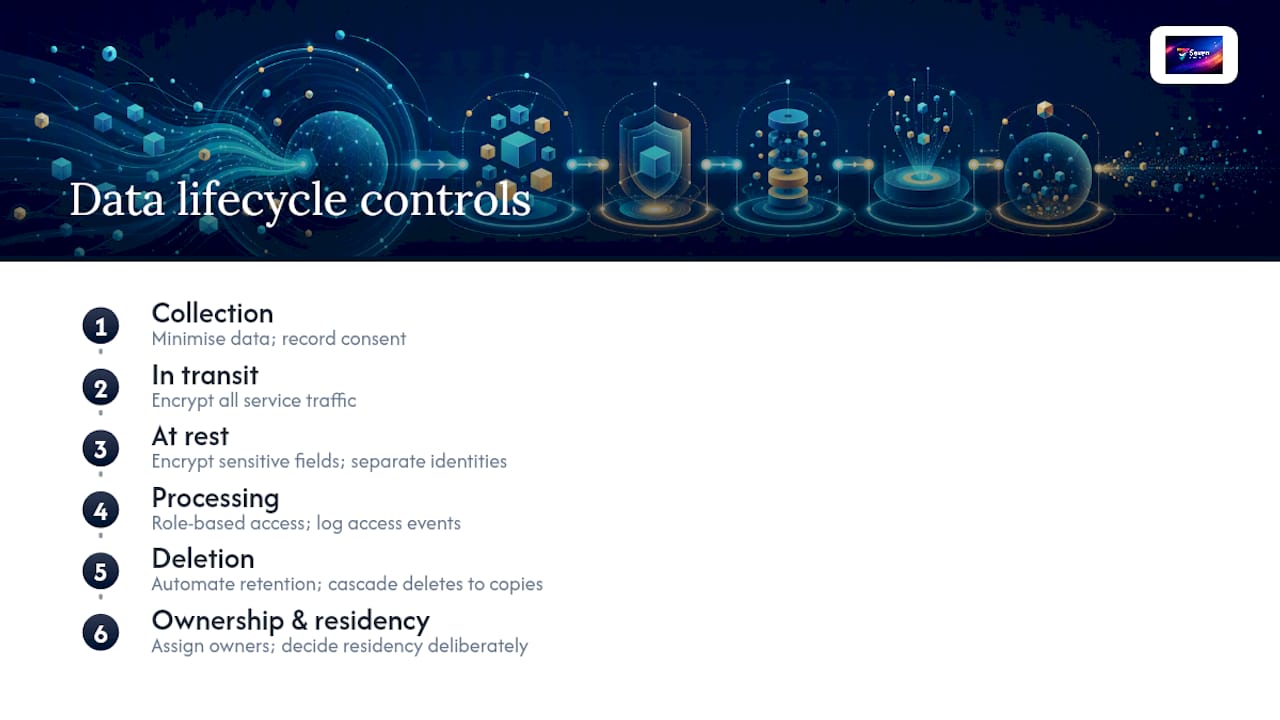
Deletion is the stage organisations underinvest in. Retention schedules need to be enforced automatically, not tracked in a spreadsheet someone checks quarterly. If your platform lets a user delete their account, that deletion needs to cascade through backups, logs, and any third-party services holding a copy of their data, not just the primary database. This is where secure file storage practices matter as much as encryption standards: a deletion request that misses an attachment archive or an old export file isn’t a completed deletion, it’s a partial one that will surface in an audit.
Data residency adds another layer. Where data physically sits determines which laws apply to it, and architecture decisions around residency need to be made deliberately, not as a side effect of picking the cheapest cloud region. Full lifecycle protection means every stage, from the moment data enters your system to the moment every copy of it is gone, has an owner and a control attached.
Challenges and common pitfalls in implementing privacy by design
The biggest pitfall isn’t technical, it’s sequencing. Teams design the feature, build it, then call in a privacy reviewer near launch, at which point the only options are delay the release or ship with unresolved gaps. Privacy requirements arrive too late to shape the architecture, so they get watered down to fit what’s already been built.
A second common failure is scope creep in data collection. Product teams add “just one more field” to a signup form or event payload because it might be useful later, and nobody revisits whether it’s still needed. Six months on, you’re storing data with no clear purpose, which is both a regulatory liability and a genuine security risk, since data you don’t hold can’t be breached.
Cross-team ownership gaps cause a third recurring problem. Privacy sits at the intersection of legal, product, and engineering, and when no single person owns it, each team assumes someone else is covering it. The result is a privacy policy that promises one thing and an actual system architecture that does another, a gap that only surfaces when a regulator or a security researcher goes looking.
Fourth, teams sometimes treat pseudonymisation as anonymisation. Pseudonymised data can often be re-identified when combined with other datasets, so it still carries regulatory obligations. Treating it as fully anonymous is a documentation error that becomes a legal problem the moment it’s tested.
Finally, vendor sprawl undermines otherwise solid internal practice. You can build airtight data handling in-house and still leak privacy guarantees through a third-party analytics tool or a support platform that wasn’t properly vetted before integration.
Integrating privacy by design with security frameworks and risk management
Privacy and security overlap heavily, but they’re not the same discipline, and treating them as identical creates gaps. Security protects data from unauthorised access. Privacy governs whether data should be collected and processed at all, and under what conditions, regardless of how well it’s secured.
The practical fix is running both threat models side by side during architecture review, rather than security first and privacy as an afterthought. A security threat model asks who could breach a system. A privacy threat model asks what harm follows if data is used exactly as intended but a user never expected or agreed to that use. Both belong in the same review meeting.
Risk registers should carry privacy risks alongside security and operational risks, scored on the same likelihood and severity scale, so they compete for the same prioritisation attention rather than sitting in a separate document that gets reviewed less often. Where your organisation already runs a formal risk framework, privacy controls slot into that structure rather than needing a parallel process.
Technical controls tend to serve both goals at once. Encryption protects against breach and limits what a malicious insider can see. Access controls restrict who can view data for both security and privacy reasons. Data minimisation shrinks your attack surface while also reducing your privacy exposure. Partner resources on data security controls and hosting security practices are worth reviewing when you’re setting technical baselines, since sound security architecture is a prerequisite for privacy by design, not a substitute for it.
The role of organisational culture and training in supporting PbD
Privacy by design collapses without cultural buy-in, no matter how good the technical architecture is. If engineers see privacy as legal’s problem, and legal sees it as a technical implementation detail, nobody actually owns it.
The organisations that get this right appoint someone accountable, a chief privacy officer or equivalent role with real authority, not just a title. That person needs the mandate to say no to a feature that violates privacy principles, and the resourcing to review designs before they ship, not after.
Training matters more than most engineering teams expect. A one-off onboarding module on data protection law doesn’t change day-to-day decisions. What works better is embedding privacy considerations into the same rituals engineers already follow, code review checklists that flag new data collection, architecture review templates that require a privacy threat model, and definition-of-done criteria that won’t let a ticket close without a privacy acceptance check.
Culture also shows up in how mistakes get handled. Teams that punish engineers for surfacing privacy concerns late in a project train people to stop raising them. Teams that treat a caught privacy gap as a process win, evidence the review step is working, get more issues flagged earlier, when they’re cheap to fix.
Cross-functional governance closes the loop. Privacy, security, product, and legal need a shared forum, even a lightweight monthly review, where decisions about data use get made jointly rather than each function assuming the others have it covered.
Emerging trends and future directions in privacy by design
Privacy-enhancing technologies (PETs) are moving from academic novelty to production tooling. Techniques like differential privacy, homomorphic encryption, and federated learning let organisations extract useful insight from data without centralising or exposing raw personal information, and they’re increasingly viable for mainstream engineering teams rather than just large research labs.
Automation is reshaping how PIAs get done. Instead of a manual document produced once per project, tooling is emerging that can scan data flows and flag privacy risks continuously, closer to how static analysis tools already work for code security. This shortens the gap between “we built something” and “we know what it does to user data.”
Regulatory pressure is broadening beyond the EU and UK. More jurisdictions are adopting design-by-default obligations similar to Article 25, which means the practical advantage goes to organisations that already build this way rather than those retrofitting to catch up each time a new regulator publishes a requirement.
AI systems are pulling privacy by design into new territory entirely. Training data provenance, consent for secondary use, and the right to have personal data excluded from a model are questions the original seven principles didn’t anticipate but map onto reasonably well once you treat a model as another stage in the data lifecycle. Expect privacy impact assessments to increasingly include a dedicated section for AI and automated decision making, given how fast that risk category is growing relative to traditional processing.
Author perspective: starting PbD in your organisation
The single biggest predictor of whether privacy by design actually sticks is whether one named person owns it, with enough authority to slow a release. Without that, it’s a slide deck. Start small: run one real PIA on your next feature, add a privacy acceptance criterion to your backlog, and build a cross-functional review before you try to boil the ocean.
— Greg
How Seven supports privacy-first teams
Seven positions itself as a privacy-first alternative to conventional project platforms, emphasizing no data mining or analytics sales, with design focused on lifecycle privacy principles. The platform includes features to support traceability of tasks to privacy requirements and secure file attachments designed to limit exposure of sensitive project data.
If your team is evaluating tooling with privacy obligations in mind, start with Seven’s security and compliance page to see how the platform handles data residency and access controls, then try the Seven platform itself with the 7-day free trial to see whether it fits how your team already works.
Sources
- Privacy by design — Wikipedia
- Regulation (EU) 2016/679 — Article 25 (UK legislation copy)
- Privacy by design — OAIC
- Privacy by Design (PbD) — New Zealand Digital Government
FAQ
What are the seven principles of privacy by design?
They are: proactive not reactive, privacy as the default, privacy embedded in design, full functionality (positive-sum), end-to-end security, visibility and transparency, and respect for user privacy, as set out in Cavoukian’s foundational framework.
Can you give an example of privacy by design?
A signup form that collects only an email address by default, rather than name, phone number, and address upfront, and only asks for extra detail when a specific feature actually needs it, is a straightforward example. Automated data deletion after a defined retention period is another.
What are the seven principles of secure by design?
Secure by design doesn’t have one universally agreed list of seven principles the way privacy by design does; definitions vary by framework and organisation. It generally shares privacy by design’s proactive, default-safe philosophy but focuses on preventing unauthorised access rather than governing what data should be collected at all.
What best describes privacy by design?
Privacy by design is an approach that embeds privacy protections into systems, defaults, and business processes from the earliest design stage, across the full data lifecycle, rather than adding privacy controls after a system is already built.
Is privacy by design a legal requirement?
Under GDPR Article 25, yes, for organisations processing personal data under EU or UK regimes it’s a binding obligation, not just good practice. Other jurisdictions increasingly reference similar design-by-default expectations, so check the specific regulator and statutory test that applies where you operate.